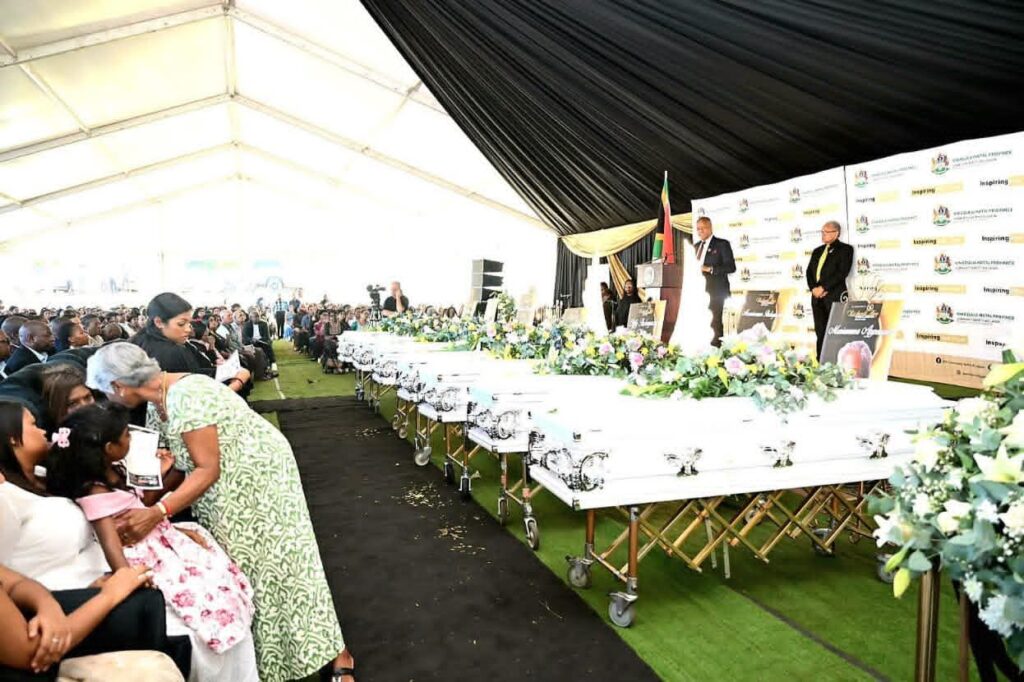
Seven members of the Monswamy family were laid to rest in KwaDukuza on Sunday, 26 April 2026, after a case that has left KwaZulu-Natal and the wider country deeply unsettled. The family was killed following a home invasion in Newtown, near Mandeni, in what police have described as a coordinated attack that ended in multiple murder charges.
What has kept the case in the public eye is not only the brutality of the crime, but the speed at which it has moved into court proceedings, where questions about justice, punishment, and public safety are already taking centre stage.
What the Monswamy Family Murder Case Reveals About KwaDukuza Crime and Trust
The Monswamy family murder in KwaDukuza began on the night of 21 April 2026, when armed suspects entered the family home in Newtown, a rural area near Mandeni on the KwaZulu-Natal North Coast.
Inside the home were seven family members. Police reports confirm they were overpowered, robbed, and later taken from the property. The attackers then forced the victims into a vehicle and drove them approximately 200 kilometres to the Melmoth area, where they were killed.
The victims included Alan Monswamy, his wife, Sandy Monswamy, their children, Kraidon Monswamy and Shamarie Monswamy, and elderly relatives, Mooniamma Padayachee, Mariamma Appanah, and Cliffy Padayachee.
Beyond the confirmed sequence of events, what continues to draw attention is the suspected link between one of the accused and the family. Reports indicate that one of the suspects may have previously worked for the household. If confirmed in court, this detail shifts the case from a random act of violence to one rooted in proximity and access.
In many rural KwaZulu-Natal communities, trust plays a central role in daily life. Homes are often not heavily fortified, and people rely on familiarity rather than strict security systems. This case has directly and painfully challenged that reality.
- Also Read | Monswamy Family Murder in KwaDukuza, KZN: Funeral Held for Seven Victims as Death Penalty Debate Resurfaces
KwaDukuza Magistrate’s Court Proceedings and What Police Have Confirmed
The court proceedings in the Monswamy family murder case have already begun drawing strong public attention in KwaDukuza.
Three suspects, aged 21, 26, and 28, have appeared in the KwaDukuza Magistrate’s Court facing charges of kidnapping, robbery, rape, and murder. According to court updates, the accused abandoned their bail application during their initial appearance, meaning they will remain in custody as the case continues.
This decision has been widely interpreted as a sign that the matter will proceed as a serious, high-profile trial, with limited early release options for the accused.
Police have also confirmed that investigations are still active. Two additional suspects are reportedly being sought, with one believed to be linked to the stolen family vehicle. This suggests the case may still expand as evidence is tested in court.
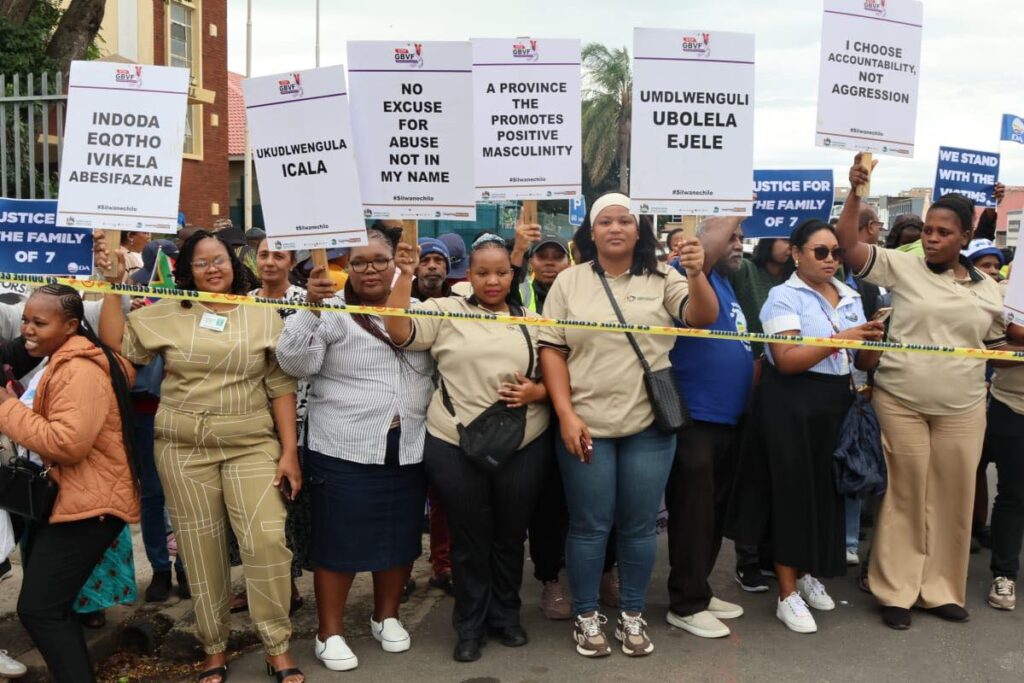
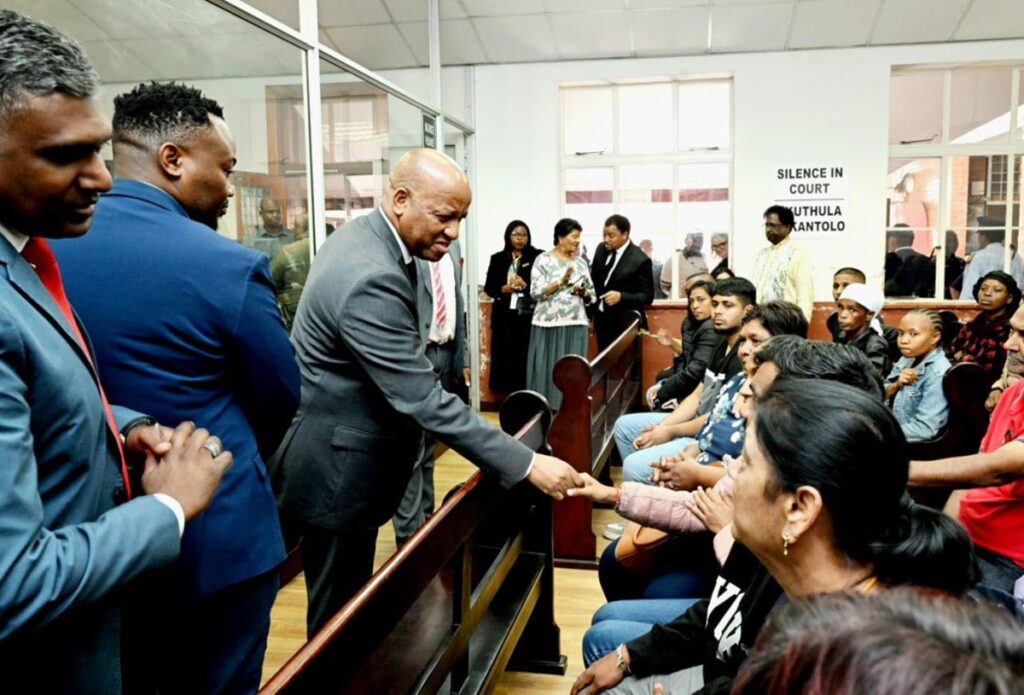
Outside the courthouse, the atmosphere has been intense. Protesters, community members, political figures, and government representatives gathered to demand that bail be denied and that the justice system act swiftly.
Among those present was KwaZulu-Natal Premier Thamsanqa Ntuli, who joined mourners and officials in expressing condolences and support for the grieving family.
The presence of political leadership at court proceedings reflects how quickly the case has moved beyond a local crime story into a wider public issue.
- Also Read | Dithapelo Innocent Letlhwanye Missing in Kuruman, Northern Cape After Meeting with RAF Lawyer
Who the Suspects Are in the Monswamy Family Murder Case in KwaDukuza
Three suspects have been identified and are currently facing multiple charges linked to the Monswamy family murder case in KwaDukuza.
The accused are:
- Linda Mthiyane
- Bongumenzi Mpungose
- Luyanda Mthiyane
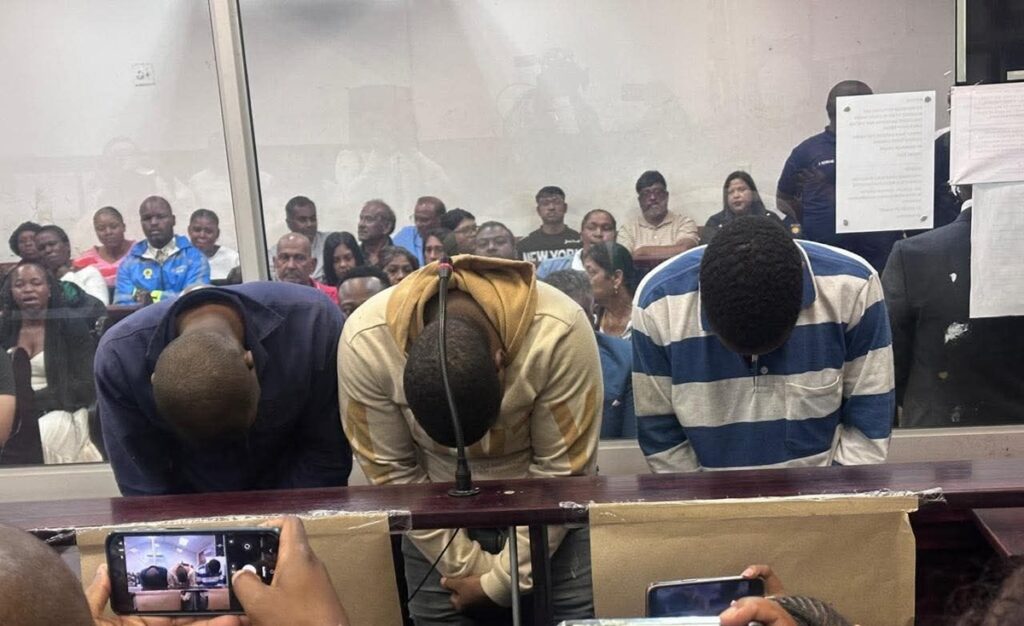
They are facing charges including kidnapping, robbery, rape, and murder following the killing of seven family members in Newtown, near Mandeni, in KwaZulu-Natal.
Court proceedings have confirmed that all three remain in custody after abandoning their bail application during their first appearance in the KwaDukuza Magistrate’s Court.
Police investigations are ongoing, with reports indicating that further suspects may still be linked to the case.
The Monswamy family murder case has become more than a court matter. It has raised questions about how safety is understood in rural KwaZulu-Natal and how quickly that sense of security can collapse.
Newtown, near Mandeni, is described by residents as a quiet rural area where people are familiar with one another. Homes are often less fortified than those in urban centres, and security is based largely on community awareness rather than technology or heavy policing.
This case has disrupted that assumption.
The alleged involvement of someone familiar with the household has also intensified public discussion. While the matter remains before the court, the idea that access and trust may have played a role has become a central point of concern for many residents.
This is not the first case in KwaZulu-Natal where rural households have been targeted in violent crimes involving robbery and kidnapping. Similar incidents have been reported in different parts of the province, raising ongoing concerns about rural policing capacity and response times.
At the same time, the emotional impact on the community remains visible. The funeral held in KwaDukuza brought together relatives, neighbours, and members of the public who came to pay final respects to the seven victims.
The scale of the loss, involving three generations of one family, has made the case particularly difficult for many to process.
- Also Read | Hermina Christina Tellis Missing in Boksburg, Gauteng: DNA Test Pending After Body Found in Ongoing Search
Courtroom Pressure, Public Outrage, and the Death Penalty Debate in South Africa
As the Monswamy family murder case continues in court, it has already become part of a wider national debate about crime and punishment in South Africa.
The decision by the accused to abandon bail has added to public tension around the case. For many in attendance outside the court, the focus is not only on the trial process but on whether the justice system can deliver outcomes that reflect the severity of the crime.
This has also reopened discussions around sentencing laws, including repeated public calls for harsher punishment in cases involving mass killings and family violence.
While South Africa does not allow capital punishment under its Constitution, the debate often resurfaces during high-profile murder cases. Some argue that the current system does not go far enough in deterring violent crime, while others maintain that strengthening investigations and prosecution is a more effective long-term solution.
What makes the Monswamy case different is the combination of factors now under public discussion:
- multiple victims from one household
- allegations of kidnapping and long-distance transport
- suspected insider involvement
- and ongoing arrests linked to the case
Together, these elements have placed the case at the centre of both legal and social debate.
Readers can follow more related cases on our website as similar incidents continue to emerge across KwaZulu-Natal and other parts of South Africa.
The Monswamy family murder case remains under active investigation, with police confirming that further arrests are still possible. Court proceedings are expected to continue in the KwaDukuza Magistrate’s Court as evidence is presented and tested.
For the community, the focus now shifts between mourning and waiting. Mourning the loss of seven family members, and waiting for a justice process that many hope will bring clarity and accountability.
As the case develops, it continues to raise difficult questions about safety, trust, and the future of crime prevention in rural South Africa.
Active Missing Persons in South Africa
Across South Africa, many families are still searching for loved ones who have not returned home. Each case carries its own story and community appeal. If you recognise any of the names below or have information that may assist, please come forward and help bring answers to these families.
- Lindokuhle Siyoyo – Last seen in KwaZulu-Natal
- Duncan Gerhard Koekemoer – Missing person case update
- Gabriel Toyana – Ongoing investigation
- David Waterboer– Missing since Friday, 7 February 2025, Northern Cape
- Kelebogile More – Community appeal for information. Missing since 14 February 2026
You can view the full list of active cases on our Missing Persons in South Africa – Latest Updates page.
Be the first to know – Join our WhatsApp Channel for content worth tapping into! Click here to join!







Leave a Reply